Your trainer says you need to use “high value” reinforcers for your dog. But what exactly does that mean? Learn what we mean by reinforcer, and how to know if your treats are high, medium or low value when training your dog.
What is a Reinforcer?
The reinforcer is the thing your give your dog after they perform a behavior you like. By definition, the reinforcer will reinforce the behavior and cause it to occur again the next time you ask for it. So if you give your dog a piece of chicken after you call him to come to you, the chicken makes it more likely that your dog will come to you again the next time you call. In this article I am going to use the terms treat, reward and reinforcer interchangeably.
One of the axioms of dog training is that “the learner gets to choose the reinforcer”. That means that your dog (the learner) gets to decide what treats will (or will not!) reinforce his behavior. Here is a starting point that works for most dogs.
What is the value of your Reinforcer?
The problem with rewards is that they have relative value. The value of your treat is inversely proportional to the level of distraction in the environment. This is why your dog will jump through hoops (literally) for a cheerio in your house, but will barely acknowledge your existence if you offer a cheerio in training class. Of course, if you have the amazing dog that will work for cheerios in even the most distracting of environments, rejoice! You are the lucky one. Everyone else, read on.
What this all means for the average dog owner is that the training treats you use in class and out and about in the real world need to be very, very high value. Your reward needs to trump the environment to the point that your dog will work for the treat in your hand rather than try to chase that evil cat that taunts him every day. In the classroom, your treat needs to trump the desire to go and play with the puppy across the room. This is where knowing your dog’s treat hierarchy comes in handy and making sure you have something in your pocket to trump ALMOST every level of distraction. Squirrel?
High Value
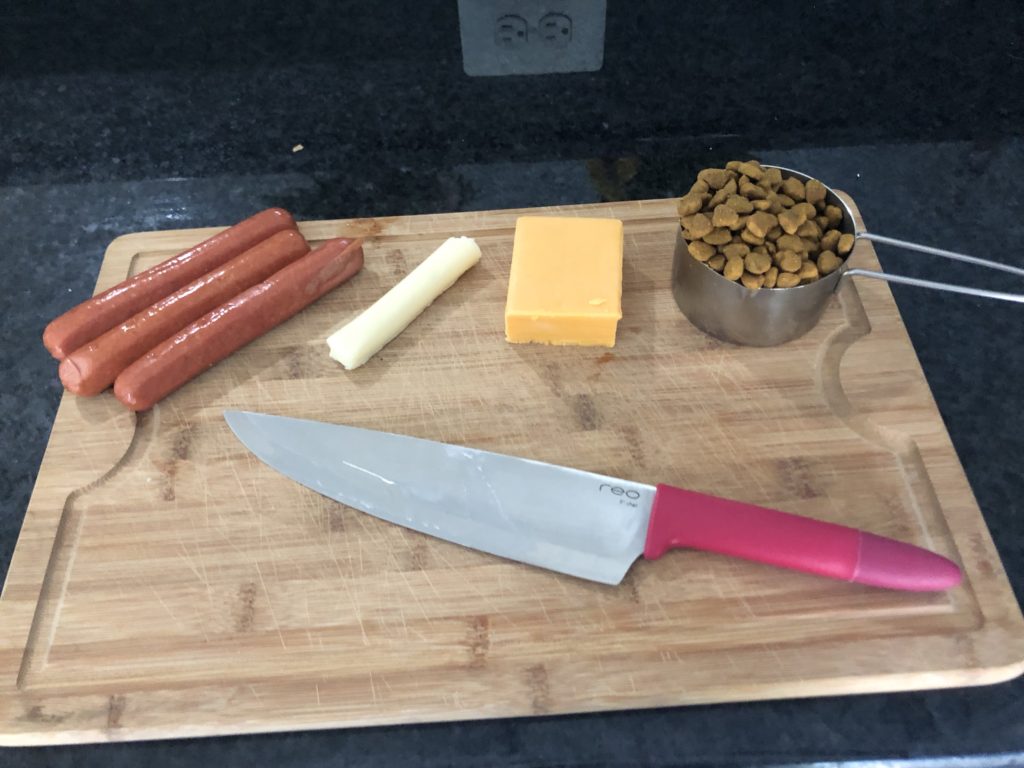
Top of the list for most dogs: any type of real meat that is not freeze dried. This might include:
- Rotisserie chicken
- Hot dogs
- Meatballs
- Turkey
- Sandwich meat
A close second is any type of real cheese, diced or sliced. For example:
- Block cheddar cheese
- Mozzarella cheese sticks
- Shredded cheese (small dogs)
Next is any of those same products in their pure freeze-dried version. Single source foods are generally higher value than processed foods, with the added benefit that you know exactly what you are giving your dog.
Moderate value
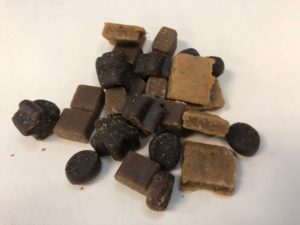
For most dogs, the middle of the list includes “soft” store bought training treats. There are a lot of different brands and they generally all look similar: slightly moist, round or square. Some are definitely better than others and the general rule is the stinkier the better. These are the “She loves them at home” culprits. High enough value to make your dog a maniac in the house, but just low value enough to bomb as soon as things get interesting outside or at class.
Think this might be the case? Try feeding the treat in the kitchen, then again out on walk. Is your dog just as interested in the treat when you get outdoors?
Low Value

Near the bottom of the list are the dry treats.
- Biscuits and dry bone shapes
- Cracker-like treats
- Any flavor of prepared treat that is not soft or squishy
- Kibble
You may find that store-bought treats have a similar value to your dog as kibble. If that’s the case, you may as well use their regular dog food for training.
Treat Hierarchy — Which value do you need?
How do you know if you’re using the right value treats? Easy! If your dog is working for your treats, you have chosen well. If your dog is not working for your treats, bump it up to the next level. Your dog will always let you know.
This is a common plan for many dogs:
High Value
- For challenging exercises at class
- Near major distractions on walks
- When visitors come by
- Practicing recall (come when called)
Moderate Value
- For quiet exercises in class, like settling on the mat while teacher is talking
- For quieter parts of your walks
Low Value
- When training around the house
- When training around low distractions
Your job is to figure out what treat will work for your dog under which circumstances. This requires some trial and error. Gather the treats that you think will work and then see if your dog will accept them under different circumstances. Then, when you go to train, make sure you have the treats you think will work but have something even better in reserve. Just in case. If you get stuck in a situation where your dog isn’t interested in your treats, your training session is over. You can’t do positive reinforcement training without reinforcement.
So get the most bang for your training buck by making sure you have the right reinforcement for the job. When training your dog, there are a lot of variables you can’t control. Your treats shouldn’t be one of them.